Bangladesh’s apparel traders need to explore EU market potentialities
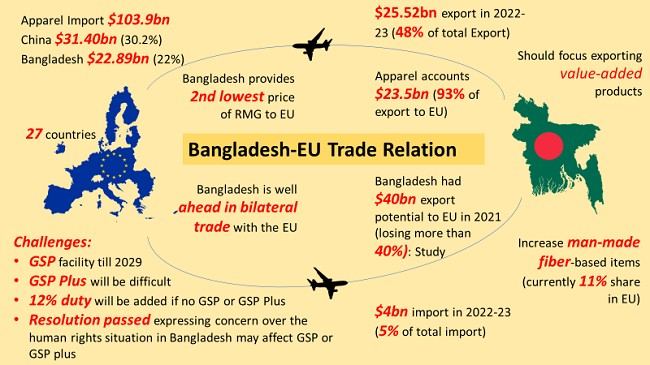
According to a study conducted by Research and Policy Integration for Development (RAPID), Bangladesh is losing more than 40% of its export potential to the European market due to lack of diversified products and standardized certification. The study estimated that Bangladesh had a total export potential of $40 billion to the EU in 2021, of which $23 billion was utilized.
However, of the remaining $17 billion unutilized, $2.5 billion was in non-apparel items. This means that there is a lot of potential for our RMG trade in the EU which we still did not tap.
The European Union (EU) has long been a major market for Bangladeshi products. 48 percent of Bangladesh's total product exports go to 27 EU countries. Annual exports are about $25 billion. In contrast, imports from the EU are less than $4 billion (5% of total import). As a result, Bangladesh is well ahead in bilateral trade with the EU..
According to the data of the Export Development Bureau, Bangladesh's product exports to the EU in the last financial year 2022-23 were $25.52 billion. 93 percent of the total exports of Bangladeshi products to the EU are ready-made garments. Last fiscal year, the country exported $23.53 billion worth of apparel, which is more than 50 percent of the total apparel exports.
In 2022, EU countries imported $103.9 billion worth of ready-made garments from different countries .
Among them, China was ranked first with 30.2% market share, exported $31.40 billion worth of clothing. Bangladesh is the second top garment exporter in this market with 22% share, exported $22.89 billion worth of ready-made garments. China's garment production is declining in the current geopolitical situation and foreign buyers are shifting their purchase orders from China. Bangladesh has the opportunity to grab these shifting orders.

Building innovation eco-system for a sustainable textile and apparel industry.
Bangladesh’s textile and apparel industry has mastered scale. Its next global advantage must be the ability to convert knowledge, technology and collaboration into repeatable commercial value. The urgency is visible in the World Intellectual Property Organization’s Global Innovation Index 2025, Bangladesh ranks 106th among 139 economies, unchanged from 2024. It ranks 115th in innovation inputs but 95th in outputs.
However, the garment industry has reached a strong foothold in this market in the last two decades for preferential market facilities or GSP. In 2026, Bangladesh will be added to the developing list from the list of least developed countries (LDCs), but the facility will remain for the next three years i.e., 2029.






Georgia Reader Reply
The apparel relationship between Bangladesh and Europe is built on a massive economic interdependence. Bangladesh acts as a high-volume, cost-effective manufacturing engine for major European fashion retailers. In return, European brands provide the primary financial lifeline that sustains millions of jobs and drives Bangladesh's export economy..